|
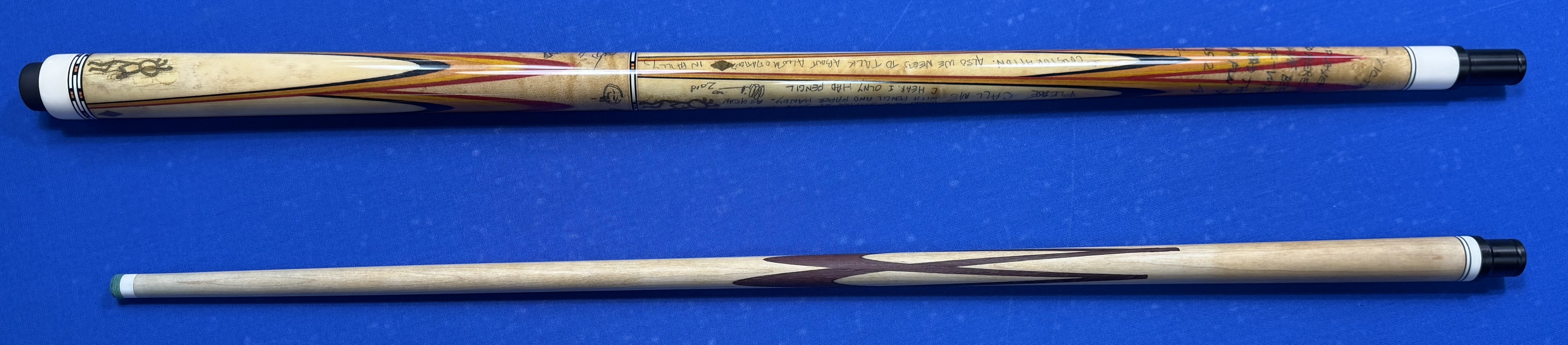
About this Cue, a Lost Treasure Discovered by Jan Carl
When I began this undertaking, I wasn’t sure where to begin. So, first let me introduce Dennis Dieckman with this entry from the Cuemaker’s Hall of Fame. Dennis Dieckman: Inducted
2008 Below is a link to an interview with Dennis after he was inducted into the Hall Of Fame. https://www.youtube.com/watch?v=UMwm5_za-Xc
I’d also like to give you a little background about Mercedes Gonzales. She came to the United States from Columbia in the late 1990’s. She settled in South Florida. Her passion for 3-cushion billiards compelled her to become part of the 3-cushion billiard community. Mercedes quickly became an established player and very well-known and admired amongst other players.
How this cue came to be is a fascinating story. I had only met Dennis a handful of times, while playing in 3-cushion tournaments in the early 2000’s. He was quite a character to be sure but was a wonderful guy and a great cue builder. Around that same time period, I also met and became friends with a young 3-cushion player. A young lady named Mercedes Gonzales. She has since become an accomplished player and is very well known amongst 3-cushion players. I lost touch with Mercedes for almost 20 years until I retired to south Florida around 2020. We met again by chance at a 3-cushion tournament at Boynton Beach. We instantly rekindled our friendship. Like many friends I have, our friendship existed primarily in the poolroom. Even so, she has become a very good friend. Dennis had also become very good friends with Mercedes in those early years. Towards the end of his life, Dennis was fighting cancer, from his exposure to agent orange while serving in Vietnam. During the last few months of his life, he was very weak and Mercedes stayed with him to help him with the things he was unable to do. Shortly before he passed away, he wanted to thank Mercedes for all her help. He didn’t have a lot of money, but he had many cues in his shop. Some finished, but most were unfinished. Most only needed the ferrule and tip installed and the shaft turned to its final dimension. He told her to sell them as a way of showing his gratitude for all she had done for him. Many years later, after we had rekindled our friendship, she knew I had become a cue builder and told me about all these cues she had. She asked if I could help her finish them. Cue building was more of a passion for me, rather than a business. But being retired now, I had plenty of time and of course agreed. Most were simple to complete. But there was one cue that presented many problems to complete. Dennis must have had this cue in his shop for a long time. He apparently was using it as a notepad. Scribbling notes and memos on it over the years. I guess he thought when he finally finished the cue and turned it on his lathe to its final dimension, all the writing would be cut away. Unfortunately, he passed away before he could ever complete the cue. When I first saw this cue, I thought it would be impossible to finish. Especially because Mercedes did not want to sacrifice all the precious notes and memos that Dennis had scribbled onto the cue. A year later I had asked Mercedes if she ever did anything with the cue. She said she hadn’t. I told her of my idea to complete the cue. Although there were several concerns, I told her of my idea. The joint collar and pin were missing. The collar was simple but matching the custom ring that Dennis had made so many years ago would be impossible. But I could use a similar ring that would be acceptable under the circumstances. The shaft was very raw. It had Dennis’s signature butterfly but was otherwise pretty much a tapered dowel. But this could be completed without much difficulty. The biggest problem was not sacrificing the writings on the butt. It was still oversized by about 60 thousandths. Or about 1/32 of an inch. Plus, one of the most important steps in applying a finish, is to sand and clean the cue thoroughly and remove all dust and fingerprints. Without this important step, there was a real possibility of destroying the cue. But this could not be done and still preserve the notes and memos. So, with great trepidation, I decided to skip this step and proceed with great care. I was very grateful to successfully apply the finish, which amazingly enhanced the memos and notes. It actually came out beautiful. Much to my surprise and relief. The weight was another issue. Dennis had used white cedar instead of maple, which is heavier and added to the problem. But fortunately, even though the cue was slightly oversized, the final weight was 20.6 ounces with the wood shaft. I also made a carbon fiber shaft for the cue which brought the weight to just under 20 ounces. This was more than acceptable under the circumstances. Being able to complete this cue was a very emotional undertaking. I didn’t want to destroy this precious part of 3-cushion billiard history or disappoint my dear friend Mercedes. I’ve built several very beautiful cue sticks over the years. But I can’t imagine there will be another cue I could be prouder of being able to work on.
|
|
If you are interested in purchasing this cue, click on
the picture.
|